News Flash
Concerned Young Australians is alive and active! Go to CYA → and read all about this new initiative of CCCA.
About Us
Our Mission
The Central Coast Conservative Alliance is a community-driven organisation dedicated to promoting conservative values across the Central Coast region. We believe in limited government, individual liberty, strong families, and the preservation of our local way of life.
What We Stand For
- Protecting individual rights and personal responsibility
- Supporting local businesses and economic growth
- Preserving family values and community traditions
- Advocating for transparent and accountable government
- Safeguarding the natural beauty of the Central Coast
Our Activities
We aim to;
- Provide informative content to commence discussion,
- Provide a site to reach out to Young Australians, below 35yrs, to hear their concerns and commence discussion. Also commence small group gatherings,
- Provide venues and opportunities to encourage notable speakers to come and present on the Central Coast and lower Newcastle areas, and
- Encourage small groups of similar interests to meet over a beer, coffee or meal.
Get Involved
Whether you're a long-time resident or new to the area, we welcome you to join our alliance. Together, we can make a difference in our community and ensure that conservative voices are heard on the Central Coast.
Contact UsLet’s Define “Conservative”
In a time when the term “conservative” carries differing interpretations, it merits closer examination.
Conservative (noun and adjective)
The word conservative derives from the Latin “conservare”, meaning “to preserve,” “to protect,” or “to keep intact.”
Its original sense concerns preservation rather than resistance to change.
A conservative is a person who believes that the accumulated wisdom of experience deserves respect, that institutions should not be changed lightly, and that progress is most durable when it builds upon what already works.
A traditional conservative asks:
“How do we preserve the house?”
A radical conservative asks:
“What is threatening the house, and what must be done to stop it?”
For example, if termites are discovered in a home’s foundations, a naïve observer may assume that the termites and the house can coexist. The radical conservative rejects that assumption.
If the termites continue to consume the structure, the house will eventually collapse. Therefore, preserving the house requires removing the source of the damage.
The goal is not destruction.
The goal is conservation.
The radical element lies in the willingness to eliminate the cause of decay, rather than manage or coexist with it.
In this sense, radical conservatism is not defined by what it seeks to destroy, but by what it seeks to preserve.
Yet a further question must sometimes be asked:
Is the house itself still worth preserving?
If the damage becomes too extensive for repair, the objective remains conservation—not of the damaged structure, but of the principles that justified its construction.
A house may be rebuilt.
Its foundations may be strengthened.
Its design may be improved.
And if the lessons of the past are carried forward, the new structure can be made more resilient than the one before it.
The purpose is not to preserve every feature exactly as it is.
It is to preserve what is valuable, protect what is essential, and ensure that each generation passes on something stronger than what it received.
A genuine environmental ethic is, in this sense, inherently conservative: it seeks to preserve natural systems rather than exhaust them.
The distinction is often not between caring and not caring, but between stewardship and exploitation under the language of stewardship.
Scrutiny is necessary to understand this difference. Preservation requires people who value what they seek to protect, understand it, defend it with reason, and remain open to debate.
As Martin Luther King Jr. reminded us, justice is not an isolated principle but a shared condition:
“Injustice anywhere is a threat to justice everywhere.”
A society, therefore, cannot preserve its integrity if it allows its foundations to fracture in principle. Preservation depends not only on structures, but on the moral coherence that sustains them.
In this sense, conservatism is not the rejection of change, but the disciplined effort to ensure that change does not destroy what is essential.
Upcoming Events
Coffee Groups – Every Friday
1st Friday of the month
Erina / Gosford / Terrigal Group
10:00 AM – 11:30 AM
The Tame Fox Café — The Industry Grounds
224 The Entrance Rd, Erina NSW 2250
2nd Friday of the month
The Entrance Group
10:00 AM – 11:30 AM
DCE Cafe, The Entrance waterfront (near The Entrance Hotel)
Shop 3, 91–95 The Entrance Rd, The Entrance
3rd Friday of the month
Umina Beach / Woy Woy Group
10:00 AM – 11:30 AM
BBF Café
Shop 4, 29–37 George St, Woy Woy
4th Friday of the month
Wyong Group
10:00 AM – 11:30 AM
Bistro at The Beachie — The Beachcomber Hotel
200 Main Rd, Toukley
Everyone is welcome to join. These groups will be casually run, and any topic can be discussed. Realistic concerns voiced by the group will be considered and presented to political parties for consideration and response.
Contact UsOne Nation
Dobell Branch Meeting
7:00 PM – 9:00 PM — Lusso Estate Function Room, Wadalba
Join us for an open discussion on local issues affecting our region. This meeting will be for members only.
Guest Speaker: Dr Barry Reed, One Nation Shortland candidate
Inaugural CCCA Dinner Dance
Mingara Recreational Club — Event Cancelled
An evening not to be missed! Speakers, live music, dancing, and a 3-course set dinner.
Family First
Turn the Tide Book Launch - Caves Beach
Saturday, August 01, 2026 at 7:00 PM — King of Kings Church, Caves Beach, Australia
Family First
Turn the Tide Book Launch - Blue Mountains
Saturday, August 08, 2026 at 2:00 PM — St Canice’s Parish Hall, Catholic Parish of Upper Blue Mountains, Katoomba, Australia
People First
Central Coast Branch Meeting
6:45 PM — Venue TBC
One Nation
Robertson Branch Meeting
7:00 PM – 9:00 PM — Everglades Country Club, Woy Woy
Join us for an open discussion on local issues affecting our region. All community members welcome.
Matt Lloyd and members of the newly formed branch committee will arrive from 6:00 PM for a meal before the meeting. You’re welcome to join us.
The Club is being very supportive of One Nation, so please consider showing your appreciation by purchasing a meal or drink.
One Nation
Dobell Branch Meeting
7:00 PM – 9:00 PM — Lusso Estate Function Room, Wadalba
Join us for an open discussion on local issues affecting our region. This meeting will be for members only.
Family First
Turn the Tide Book Launch - Wyong
Saturday, September 05, 2026 at 2:00 PM — Wyong Anglican Church, Byron St, Wyong, NSW
One Nation
Robertson Branch Meeting
7:00 PM – 8:30 PM — Woodport Hotel, Erina
Join us for an open discussion on local issues affecting our region. All community members welcome.
Matt Lloyd and members of the newly formed branch committee will arrive from 6:00 PM for a meal before the meeting. You’re welcome to join us.
The hotel is being very supportive of One Nation, so please consider showing your appreciation by purchasing a meal or drink.
Sydney Walk for Life
Saturday, September 19, 2026 at 2:00 PM — Hyde Park, Sydney, Australia
One Nation
Dobell Branch Meeting
7:00 PM – 9:00 PM — Lusso Estate Function Room, Wadalba
Join us for an open discussion on local issues affecting our region. This meeting will be for members and supporters of One Nation.
People First
Central Coast Branch Meeting
3:45 PM — Venue TBC
One Nation
Dobell Branch Meeting
7:00 PM – 9:00 PM — Lusso Estate Function Room, Wadalba
Join us for an open discussion on local issues affecting our region. This meeting will be for members and supporters of One Nation.
One Nation
Dobell Branch Meeting
7:00 PM – 9:00 PM — Lusso Estate Function Room, Wadalba
Join us for an open discussion on local issues affecting our region. This meeting will be for members and supporters of One Nation.
People First
Central Coast Branch Christmas Event
Time TBC
Want to stay informed about upcoming events?
Latest Blog Posts
Protecting the Rights of the Unborn
By Rev Aleks Pinter, Wyong Anglican Church
Last Monday night (June 2, 2026) thousands of demonstrators gathered outside the NSW parliament in Sydney, to show their support for a private member’s bill introduced by Libertarian MP John Ruddick. The Bill seeks to criminalise sex-selective abortions. It will be brought before parliament shortly. Thousands of pro-life advocates gathered, featuring high-profile speakers including One Nation MP Barnaby Joyce and campaigner Dr. Joanna Howe, to demand stricter controls on abortion. At the same time, a separate group of around 150 pro-choice and student advocates assembled in nearby Martin Place to defend abortion rights, warning that such legislation could limit women’s access to care.
The proposed legislation is the Abortion Law Reform Amendment (Sex Selection Prohibition) Bill 2025, the primary purpose of which, is to ban and criminalise abortions performed solely for the purpose of fetal sex selection.
The key provisions of the bill include:
- Hefty Penalties for Medical Providers: Penalties include a $22,000 fine and up to five years in prison or both. Corporate employers could be fined up to $42,000.
- No Penalties for Patients: Patients would be explicitly exempt from criminal penalties.
- Professional Repercussions: Performing a sex-selective abortion would legally constitute professional misconduct for registered health practitioners. It would also void their professional indemnity insurance for that procedure.
In New South Wales alone, approximately 20,000 abortions are performed each year. The vast majority of terminations (81.9%) occur early in pregnancy, less than 9 weeks gestation, before fetal sex can be determined. That still leaves over 3,500 terminations being performed after fetal sex can be established. A study conducted by researchers from Edith Cowan University and Curtin University and published in PLOS Global Public Health found evidence of slightly skewed birth ratios within certain migrant communities, which has been linked to the increasing availability of Non-Invasive Prenatal Testing (NIPT).
The Archbishop of Sydney, Kanishka Raffel has written to the Premier, the Honourable Chris Minns, and the Leader of the Government in the Legislative Council, the Honourable Penny Sharpe, to express support for the bill to prevent sex-selective abortions. The Anglican Church in Sydney has consistently opposed legislation that has the effect of expanding access to abortion. Raffel stated “We hold that abortion is not a neutral moral choice but involves the loss of defenceless human life. Nevertheless, we grieve for mothers who see no other option, affirming that in our loving God, there is forgiveness and boundless goodness and mercy.”
Raffel argued that regardless of the broader debates about abortion itself, the Bill should unite Parliament against sex-selective abortion, which disproportionately targets unborn girls. He appealed to the government stating: “My hope is that those who have in-principle support for abortion rights, on whatever ground, would nevertheless see merit in supporting this bill to safeguard our shared commitment to the dignity and equality of girl children. Far from empowering women, sex selective abortion reflects deeply entrenched cultural prejudice and belongs to crude discriminatory paradigms that contemporary and civilised societies have long sought to leave behind.”
Controversially, the Bishop of Newcastle, Dr Peter Stuart in 2019 supported the Reproductive Health Care Reform Bill 2019 which would allow terminations up to 22 weeks. Whilst Bishop Stuart said “he views all human life as sacred from its inception until death” he encouraged support for the overarching proposal to move the legal management of the termination of pregnancy from the criminal code. He argued “The healthcare regulatory framework is a better place for governing the complex decision-making associated with pregnancy and matters associated with conscience.”
A Biblical Ethic of Abortion
For most Christians, our concern is grounded in our commitment to the sanctity of human life and the inherent equality of men and women as God’s image bearers.
a. God’s Image Bearers (Imagio Dei)
Scripture affirms that both male and female are created in the image of God (Genesis 1:27), a conviction that underpins our commitment to the dignity of every human. Human value is not earned by developmental milestones (like breathing or thinking) but is inherent. This grants full human value and the right to life to a fetus from the moment of conception. Therefore, destroying a fetus is seen as destroying a bearer of God’s image.
b. God’s Foreknowledge and Handiwork
The Bible teaches that every human person is a result of God’s foreknowledge and handiwork. In Psalm 139:13–16, it says: “For you created my inmost being; you knit me together in my mother’s womb” and Jeremiah 1:5 says: “Before I formed you in the womb I knew you.” God has a personal relationship with, and a purpose for, the unborn.
c. Protection of the Vulnerable
The Bible consistently commands the protection of those who cannot defend themselves—such as the orphan, the widow, and the poor. Proverbs 31:8–9 says: “Speak up for those who cannot speak for themselves, for the rights of all who are destitute. Speak up and judge fairly; defend the rights of the poor and needy.”
Should not a biblical ethic of abortion extend this mandate to the unborn as the most vulnerable members of the human family? I think it should.
d. Grace and Redemption
In Christian ethics, we often speak of a Retrieval Ethic, which is the moral principle of drawing the greatest amount of good and limiting harm as much as possible in a broken, sinful world. Rather than relying on rigid legalism or choosing the “lesser of two evils,” it seeks to actively recover redemptive possibilities and promote God’s purposes in any difficult situation.
In a situation where a pregnancy puts a mother’s life at risk, a retrieval ethic would permit the abortion whilst still holding to points a, b and c.
Whatever the situation, we must realise that the decision to abort a pregnancy, for most women is a difficult and painful one, even if they don’t recognise it to be so, straight away.
Abortion, although deplorable, is not the unforgiveable sin. A biblical ethic of abortion demands an environment of compassion, removing condemnation for past choices, and offering healing to women facing difficult circumstances. Might the church be a place where women can find refuge, healing, grace and redemption through our Lord Jesus Christ.
If you are of the praying kind, I invite you to join me in praying that the government will lead the Parliament in taking the small but vital step of supporting this bill and protecting the rights of the unborn.
References:
New South Wales Ministry of Health. (2020). Review of termination of pregnancy for the purpose of sex selection in NSW. New South Wales Parliament. parliament.nsw.gov.au
Gebremedhin, A. T., et al. (2025). “Indirect evidence of sex-selective abortion practices to the imbalanced sex ratio at birth in Australian migrant populations.” PLOS Global Public Health, 5(5), e0004672.
Raffel, K. (2026, May 28). This bill should unite Parliament [Media release]. Anglican Diocese of Sydney. sydneyanglicans.net
Stuart, P. (2019, July 31). Letter to Members of Parliament regarding the Reproductive Health Care Reform Bill 2019. Anglican Diocese of Newcastle. (As cited in Eternity News, 2019.)
Let’s Define “Conservative”
In a time when the term “conservative” carries differing interpretations, it merits closer examination.
Conservative (noun and adjective)
The word conservative derives from the Latin “conservare”, meaning “to preserve,” “to protect,” or “to keep intact.”
Its original sense concerns preservation rather than resistance to change.
A conservative is a person who believes that the accumulated wisdom of experience deserves respect, that institutions should not be changed lightly, and that progress is most durable when it builds upon what already works.
A traditional conservative asks:
“How do we preserve the house?”
A radical conservative asks:
“What is threatening the house, and what must be done to stop it?”
For example, if termites are discovered in a home’s foundations, a naïve observer may assume that the termites and the house can coexist. The radical conservative rejects that assumption.
If the termites continue to consume the structure, the house will eventually collapse. Therefore, preserving the house requires removing the source of the damage.
The goal is not destruction.
The goal is conservation.
The radical element lies in the willingness to eliminate the cause of decay, rather than manage or coexist with it.
In this sense, radical conservatism is not defined by what it seeks to destroy, but by what it seeks to preserve.
Yet a further question must sometimes be asked:
Is the house itself still worth preserving?
If the damage becomes too extensive for repair, the objective remains conservation—not of the damaged structure, but of the principles that justified its construction.
A house may be rebuilt.
Its foundations may be strengthened.
Its design may be improved.
And if the lessons of the past are carried forward, the new structure can be made more resilient than the one before it.
The purpose is not to preserve every feature exactly as it is.
It is to preserve what is valuable, protect what is essential, and ensure that each generation passes on something stronger than what it received.
A genuine environmental ethic is, in this sense, inherently conservative: it seeks to preserve natural systems rather than exhaust them.
The distinction is often not between caring and not caring, but between stewardship and exploitation under the language of stewardship.
Scrutiny is necessary to understand this difference. Preservation requires people who value what they seek to protect, understand it, defend it with reason, and remain open to debate.
As Martin Luther King Jr. reminded us, justice is not an isolated principle but a shared condition:
“Injustice anywhere is a threat to justice everywhere.”
A society, therefore, cannot preserve its integrity if it allows its foundations to fracture in principle. Preservation depends not only on structures, but on the moral coherence that sustains them.
In this sense, conservatism is not the rejection of change, but the disciplined effort to ensure that change does not destroy what is essential.
Water Management Amendment (Easements for Inundation) Bill 2025
The NSW Government has passed a bill that legalises intentional flooding of private land, expands state power to do it operationally, and removes state compensation liability for resulting damage. This analysis examines what it means for homeowners, insurance, property values, the Central Coast and the whole of NSW.
Read full analysis →Wake Up Australians
Australians, wake up. You, the taxpayer, are paying millions of dollars to assist Chinese manufacturers. How? Every time Australian residents order from Temu or similar Chinese sellers, Australian taxpayers pay to 'subsidise' the delivery. Not Chinese taxpayers. Not the Chinese companies. You. We are actually paying for Chinese goods to cost less delivered to Australia.
YES! An estimated $76.4 million last financial year — was paid by Aussie taxes!
Why? It's part of an old agreement for "developing countries".
Is China still a "developing country"? They're certainly developing a lot of profits from Australia selling multi-story wind turbines and solar panels, plus cars, etc, ad infinitum.
The Australian government provide 'nett zero' help like this to Australian manufacturers or what's left of them. Instead, they're crushed with sky-high power bills, high wages and mountains of red tape.
As Australian factories close, Aussie workers lose their jobs, while Chinese factories get a free kick. This is your money, helping our biggest competitor, sell more of their stuff here. When will Australia get priority over this handout to foreign interests?
Who's pulling the strings?
Perhaps that's a question worth asking of the Fabian Society's Anthony Albanese.
References:
9News — AusPost subsidising China delivery
Lowy Institute — Problems with post
Fabian Society — 2020 Vision
Uniparty will sabotage One Nation
Listen up. Because what's coming next is predictable as clockwork. One Nation is surging. The polls are at record highs. The major parties are bleeding support. And when political machines start losing control, they don't look in the mirror, they attack. So here's what you're going to see. And when you see it, I want you to recognise it for exactly what it is. What's your thoughts…? Peter Lyndon-James
Read more →Resources
Books
Topher Field's bestselling books on freedom, faith and civil courage. Essential reading for Australians who refuse to be pushed around.
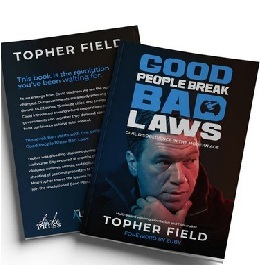
Good People Break Bad Laws - $39.00
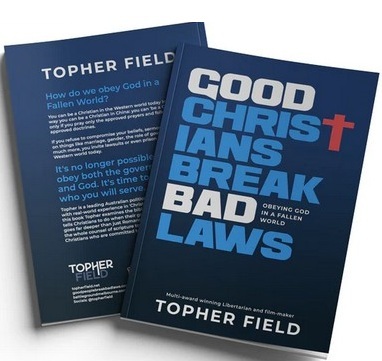
Good Christians Break Bad Laws - $39.00
What a Capital Idea - Australia 1770-1901

Dr. Christopher Reynolds B.A., B.D., Dip. Ed., M.A., Ph. D., was first listed in the International Book of Who's Who in 2006. In brief- Dr. Reynolds has held appointments with both the United States Senate and House of Representatives. He has also been the Executive Officer for the NSW Minister for Public Works, Roads, Ports and Darling Harbour, and the Executive Director for the Sydney World Trade Centre.
“What a Capital Idea Australia 1770 – 1901” is a refreshing and exciting new perspective on Australia that emerges from insightful and dedicated research. At every turn, the research presents a fascinating story of Australia's history like never before. Yet, the scholarship is tempered with wonderful and sometimes funny stories about people and their adventures.
Dr Reynolds’ thorough research of original documents has revealed there are many errors in our previously taught history. Such as there was not a single aboriginal shot in the first 30 years of settlement. There are 486 pages of true facts.
Turn the Tide - A Letter to the Antipodean Church
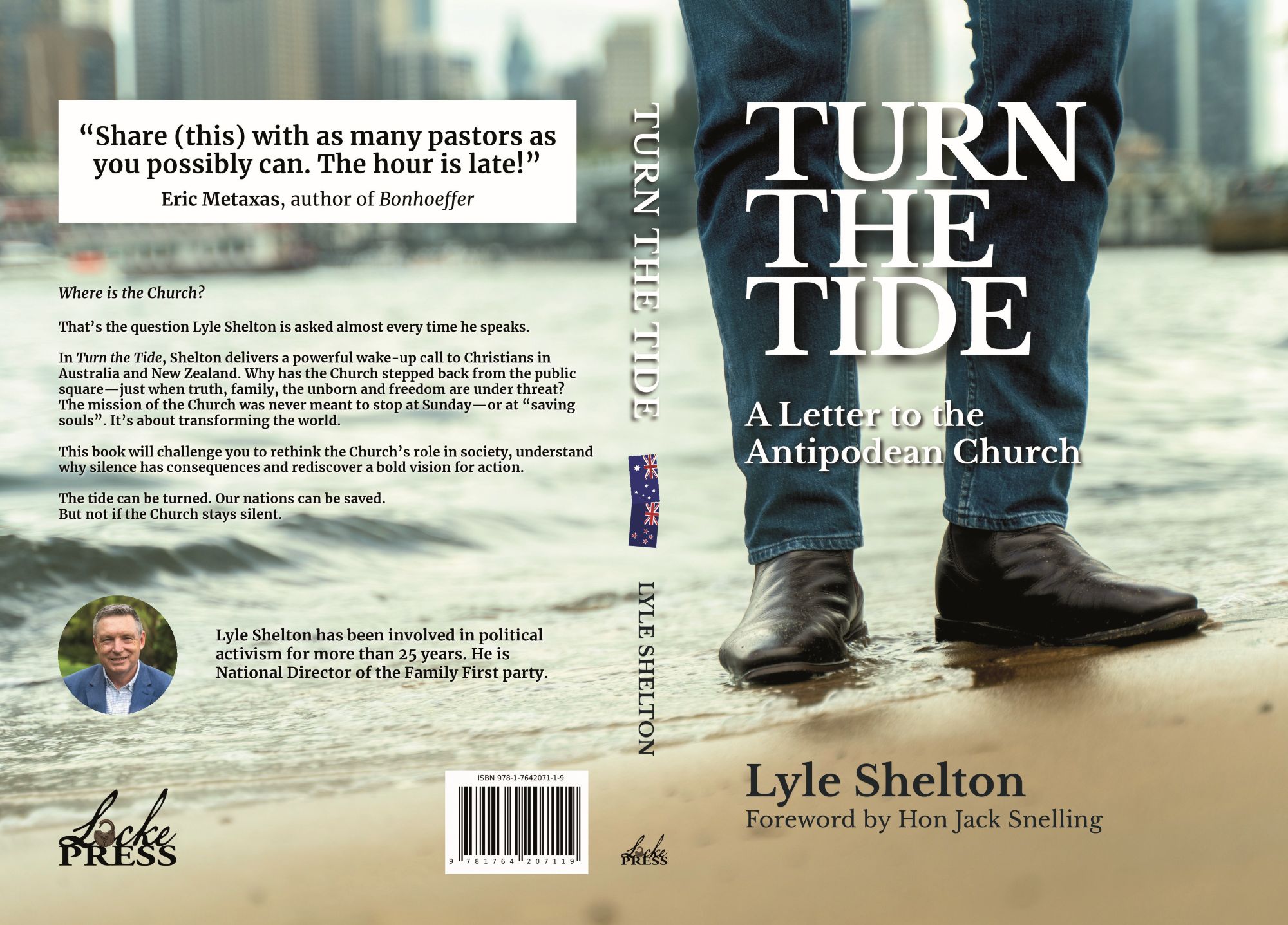
By Lyle Shelton
“Where is the Church?”
That’s the question Lyle Shelton is asked almost every time he speaks.
In Turn the Tide, Shelton delivers a powerful wake-up call to Christians in Australia and New Zealand. Why has the Church stepped back from the public square—just when Truth, family, the unborn and freedom are under threat? The mission of the Church was never meant to stop at Sunday—or at “saving souls”. It’s about transforming the world.
This book will challenge you to rethink the Church’s role in society, understand why silence has consequences and rediscover a bold vision for action.
The tide can be turned. Our nations can be saved.
…But not if the Church stays silent.
Local Government
24 Mar — Central Coast Council Meeting
Meeting YouTube link: https://www.youtube.com/live/_eg2KYCG1UQ
Central Coast Leadership Forum — Blueprint Central Coast — Growing Together
Link: CCLF Policy Document (PDF)
Citizens concerned by the lack of community involvement addressed the meeting to move not to accept the report.
Move the bottom timeline to start from 17min:00 sec
Sandra Harris address from 20m:35s
Further information can be found on Central Coast Council Watch.
NSW Government
Bills
NSW Parliament Bills from 2016 to 2026. Use the filters below to search and browse.
| Bill Title | Year |
|---|
Useful Links
Join the Alliance
Become a Member
Join the Central Coast Conservative Alliance and connect with like-minded people in your community. As a member you'll receive:
- Invitations to all CCCA events and gatherings
- Updates on local government issues that matter
- Opportunities to meet notable speakers and community leaders
- Access to small group meetups in your area
Membership is free. Fill out the form below and we'll be in touch.
Registration Form
Prefer email? Contact us directly at [email protected]
Support the Alliance
Why Your Donation Matters
The Central Coast Conservative Alliance is a community organisation run entirely by volunteers. Your donation funds events, speakers, venues, and materials that help us advocate for our community.
All donations are gratefully received and acknowledged by email.
Donor Registration
Complete the form below to register your donation. Choose your preferred payment option at the bottom.
Questions about donating? Contact us at [email protected]





Useful Links
Australians for Better Government
Australians for Better Government is dedicated to improving the way Government functions, the wording of our Constitution, and educating the public in civics to empower voters to value their role in a successful democracy.
Concerned Young Australians
Concerned Young Australians is dedicated to fostering a network of informed, confident, and connected young people who will EMPOWER THE NEXT GENERATION to value their role in a successful democracy.
Let's Rethink Renewables
We are a network of concerned Australians who are united against the Government's reckless rollout of industrial renewable projects in regional and rural communities.
Topher Field
Topher helps people make sense of the cultural and political chaos that defines modern Australia and inspires them to think for themselves.